
SAIG – SlewsIT AI Inference Gateway

AI-native API gateway engineered for high-performance inference, intelligent routing, and hardware-aware scalability.

A next-generation control layer that unifies API management, AI model orchestration, and GPU-accelerated inference across enterprise environments.

SAIG Architecture

Three-plane architecture separating control, data, and AI inference for scalable, high-efficiency AI systems.
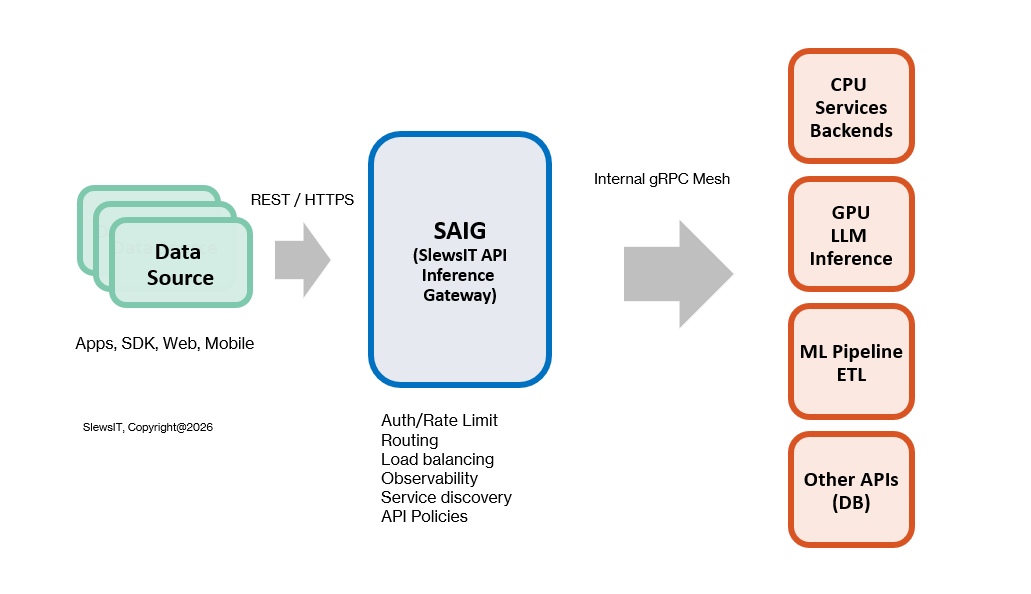
SAIG Architecture

Architecture Walkthrough

Northbound Interface: REST/HTTPS APIs for application, SDK, and client integration.

Gateway Data Plane: Stateless request processing, routing, load balancing, and streaming inference.

Control Plane: Centralized configuration, service discovery, and traffic policy management.

AI Inference Plane: GPU/CPU-based model execution for LLMs, embeddings, and ML pipelines.

Service Mesh: Internal gRPC communication between gateway and backend services.

Core Capabilities

  • AI-aware API gateway with model-based routing
  • Token-aware load balancing for GPU optimization
  • GPU memory-aware request scheduling
  • Streaming inference (SSE, WebSockets, gRPC)
  • Prompt caching for cost and latency reduction
  • Multi-tenant isolation with quotas and rate limiting
  • Integrated AI guardrails (PII masking, prompt filtering)

Deployment Evolution

Phase 1 – CPU PoC: Go-based gateway with HTTP-to-gRPC bridging and CPU inference backends.

Phase 2 – Scaled Cluster: Horizontally scalable gateway instances with distributed service registry.

Phase 3 – Hardware Accelerated: DPU offload for networking and GPU-based inference for large-scale AI workloads.

AI Routing & Inference Model

  • Model-based routing (LLMs, embeddings, search)
  • Region and tenant-aware routing policies
  • Dynamic routing based on GPU availability and queue depth
  • Support for heterogeneous compute (CPU, GPU, DPU)

Use Case – Enterprise LLM Gateway

An enterprise deploying multiple AI models requires unified access, cost control, and performance optimization.

  • Applications send inference requests through SAIG.
  • Gateway routes requests to optimal GPU clusters based on model and load.
  • Token-aware balancing maximizes GPU throughput.
  • Observability tracks latency, tokens, and utilization.

Outcome: Reduced AI infrastructure cost with improved latency and centralized governance.

Observability & Control

  • Real-time metrics (latency, tokens/sec, throughput)
  • Distributed tracing across inference pipeline
  • GPU utilization and queue monitoring
  • Centralized configuration and policy management

Technology Stack

  • Gateway: Go (high-performance networking)
  • RPC: gRPC service mesh
  • Config & Registry: etcd / Consul
  • Metrics: Prometheus
  • Tracing: OpenTelemetry
  • Cache: Redis
  • Orchestration: Kubernetes

Business Impact

  • Optimize GPU utilization and reduce AI costs
  • Enable scalable enterprise AI deployments
  • Centralize AI access and governance
  • Improve inference latency and throughput
  • Accelerate AI platform standardization